
Payments and transactions: Two words the finance world uses interchangeably. Two concepts that could not be more different.
Closing a bond deal, paying a vendor, buying a coffee: All are routinely labeled a "transaction," even when they are really just a series of disconnected payments.
Banks call them transactions.
Your accounting system calls them transactions.
But most of the time, what they really mean is payments.
Friction, confusion, and often fraud can all be traced back to the same mistake: blurring two words that are not interchangeable.
The Confusion Starts With Language
A payment is the mechanical act of moving money.
A wire is sent. An ACH clears. A balance changes.
A transaction is the structured agreement that defines why money should move and under what conditions.
Purpose is set. Conditions are verified. Approvals are enforced.
A payment answers, “What happened?”
A transaction answers, “Why did it happen, and what needed to be true for it to occur?”
That might sound like semantics. It is not.
A Way to Think About Payments vs Transactions
Here is a metaphor that makes this click.
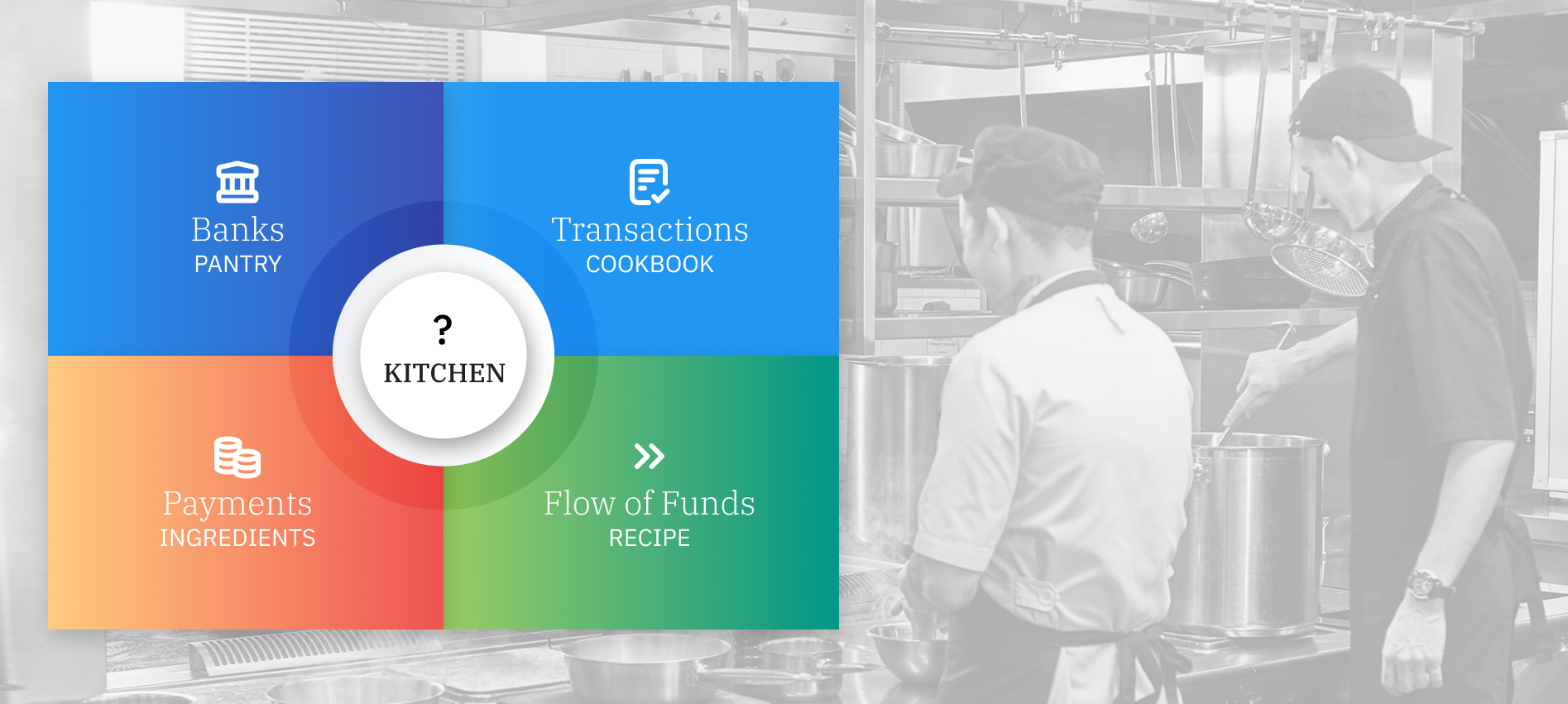
Think about what it takes to run a professional kitchen. You need a pantry to store ingredients. You need cookbooks that define what you are trying to make. You need recipes that describe the sequence. What happens first. What happens next. What must wait. You need ingredients to work with. And you need the kitchen itself, the place where it all comes together under proper controls.
Now look at what we have in finance:
- Banks are the pantry. They store funds and release them when instructed.
- Transactions are the cookbook. They define the purpose and boundaries.
- Flows of funds are the recipe. They describe the sequence.
- Payments are the ingredients. Wires, ACH, checks. The tangible things that move.
We have pantries, cookbooks, recipes, and ingredients. But we never built the kitchen. The place where transactions are enforced, sequences are followed, and meaning is preserved.
A cookbook without recipes is just an idea.
Recipes without ingredients cannot produce a dish.
Ingredients scattered across a counter without a kitchen create chaos.
Why This Distinction Actually Matters
When organizations focus only on payments, they operate at the lowest level of the hierarchy. They manage execution without managing intent.
Every movement of money feels like a fresh decision. Approvals repeat. Verifications arrive late. Risk gets handled under deadline pressure. Teams rely on memory and experience to fill gaps the system cannot see. And when those experienced people leave, the process does not degrade gracefully. It slows. Or breaks.
Here is what changes when you organize around transactions instead...
Decision-making moves upstream, where there is time to think clearly. By the time a payment is ready to execute, there is little left to debate. The transaction already defined the purpose. The flow already defined the conditions. Meetings get shorter. Exceptions become obvious. Speed increases not because pressure rises, but because uncertainty drops.
Cooks Without a Kitchen
So how have organizations been handling transactions without a kitchen? They improvise.
Email stands in for intent.
PDFs and spreadsheets stand in for sequence.
Callbacks stand in for verification.
Insurance becomes the fallback when everything else fails.
Banks store funds and release them when instructed. But they do not understand why money is moving, do not enforce how it should move, and do not preserve meaning beyond execution.
This is not negligence. It is design. Banks are built to answer one question well: “Did an authorized customer instruct us to release these funds?” Once the money moves, the story largely ends. The workarounds may function for a while. But at scale, improvisation becomes risk.
Meaning Must Come Before Money
This is where most breakdowns originate. Meaning is applied after money moves.
Instructions arrive by email. Humans infer intent. Banks execute orders. Only afterward does everyone try to reconstruct what was supposed to happen. That is forensic finance. Not transactional execution.
The fix is not more controls at the payment layer. The fix is organizing around transactions from the start.
- Define purpose first.
- Agree on sequence.
- Then execute.
What Changes When You Get This Right
When transactions are defined, patterns emerge.
When flows are intentional, coordination becomes possible.
When payments become execution steps rather than decision points, automation finally makes sense.
The hierarchy is simple:
- Transactions create meaning
- Flows create order
- Payments create movement
Organize money in that sequence and speed becomes natural. Risk becomes manageable. Systems begin working the way people always expected them to.
The Questions Worth Asking
Is your organization tracking payments, or managing transactions?
How often does your team re-explain context, reconstruct intent, or make decisions under deadline pressure that should have been settled days earlier?
Anyone can move ingredients. Cooking requires a kitchen.
Basefund helps organizations move from payment-centric operations to transaction-based clarity, so money moves with meaning, not just momentum.