
Most fake wire instructions don't fail any test we actually run on them. They look right, arrive on time, and reference the right deal. That's exactly why wire instruction forgery keeps working — and why wire instructions security has to start with provenance, not appearance.
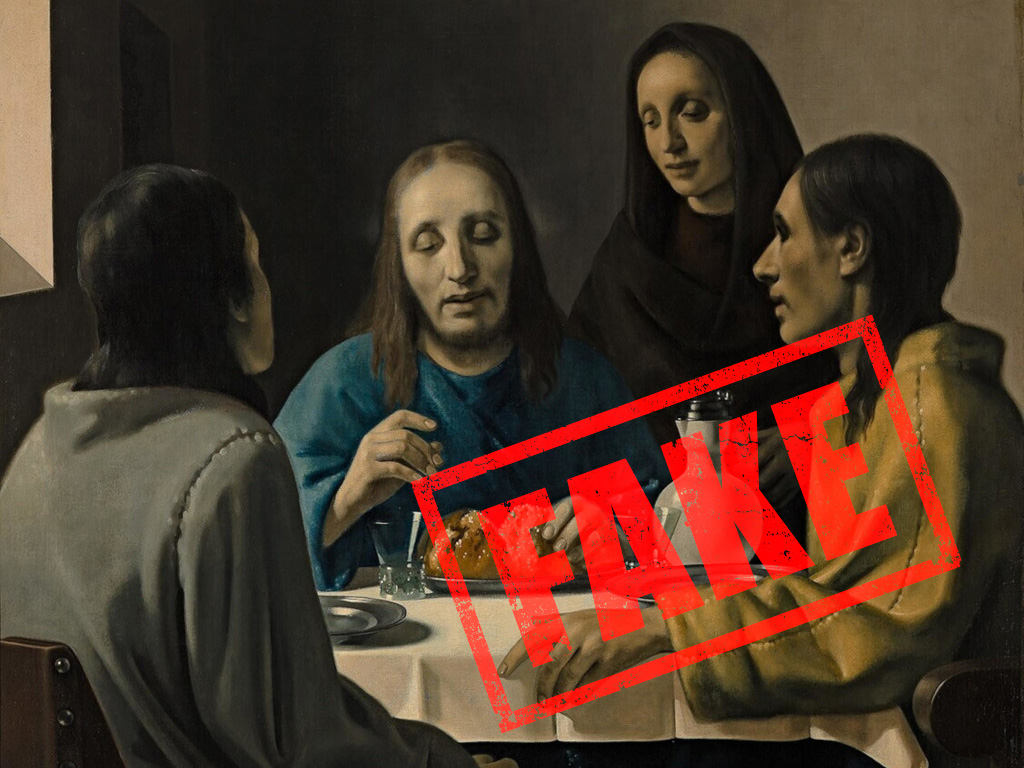
In 1937, a museum in Rotterdam paid a fortune for a newly discovered painting attributed to Johannes Vermeer. The brushwork was convincing. The pigments matched the period. The subject fit comfortably inside Vermeer's known body of work. Most importantly, it was authenticated by Abraham Bredius — one of the world's leading experts on Dutch masters. Bredius didn't hedge. He declared it a masterpiece. The painting entered the museum's collection as a genuine Vermeer.
It wasn't.
The painting was the work of Han van Meegeren, a skilled forger who had spent years studying Vermeer's technique. He mixed period-accurate pigments. He baked canvases to simulate age. He learned how to make his work look right — convincingly, confidently right.
And that was the problem.
The painting passed every test that relied on appearance and expertise. What it lacked was something quieter and harder to fake: provenance. There was no unbroken chain of custody. No documented history tracing the painting from its creation to the present day. Once that absence was understood, the illusion collapsed.
The art world learned a hard lesson from van Meegeren and the forgers who followed him. Authenticity is not a matter of how something looks. It's a matter of where it's been, who touched it, and whether that story holds together over time.
Without provenance, a painting is just pigment and canvas.
Why Fake Wire Instructions Keep Slipping Through
A wire instruction can look right. A closing memo can feel routine. A PDF can carry the right logos, the right names, and the right tone. But appearance isn't proof. If you can't trace where a wire instruction came from, how it entered the transaction, and whether it's remained intact since — it's just text and formatting, no matter how official it appears.
For years, the industry has done a good job training people to be skeptical of identity. We teach call-backs. We use known numbers. We verify out-of-band. We accept that a familiar name in an email signature doesn't prove who's actually on the other end.
We haven't trained the same skepticism for the documents themselves.
A wire instruction that looks familiar, arrives at the expected time, and references the right deal usually gets processed without question. Appearance becomes authentication. And that's exactly what wire instruction forgery relies on.
Modern fraud rarely involves inventing documents from scratch. Attackers watch real transactions unfold. They intercept legitimate communications, change a routing number or an account name, and re-insert those fake wire instructions back into trusted workflows. Everything looks right because almost everything is right.
If identity requires verification, documentation requires provenance. That's the simplest way to understand the gap at the heart of wire instructions security today.
The Three Ways Wire Instructions Get Compromised
Every wire instruction — and every transaction document that travels alongside it — is exposed in three distinct ways. Each requires a different kind of control.
1. Obtaining — How wire instructions enter the transaction
Authenticity has to exist at the point of entry. If a wire instruction isn't verified when it first enters the transaction, there is no reliable way to secure it later. Everything downstream is built on an assumption rather than evidence — and that assumption is exactly what fake wire instructions exploit.
We already know how to do this well — we just don't apply it consistently. Consider how high-stakes municipal bond documents are created. These deals require multiple layers of authentication before a single dollar moves: institutional seals establish that the organization itself has authorized the document, individual signatures confirm that people with actual authority approved it, and notary attestations verify identity, presence, and timing. That combination creates provenance at the moment of origin. The document doesn't become trusted later. It is born trusted.
Now contrast that with how most transaction documentation enters organizations today. Wire instructions arrive as PDFs attached to emails. Invoices are forwarded through long chains. Account changes appear as "updated information" with no record of how they were created or who actually authorized them. They look legitimate. But nothing about their origin has been authenticated — which is the structural condition wire instruction forgery depends on.
The stakes in a bond deal justify rigor — but the principle applies everywhere. If a document governs the movement of money, authority, or obligation, it deserves provenance at entry, regardless of the dollar amount.
2. Transit — How documents move between participants
Just like money, documents are most vulnerable when they're moving. And yet, most transaction documentation still moves through email — a system designed for conversation, not custody. Email doesn't verify recipients. It doesn't confirm documents arrived unaltered. It doesn't provide access controls once something is sent. It doesn't create an audit trail of who viewed, downloaded, forwarded, or modified an attachment.
Once you click send, the document leaves your control entirely. That's not a flaw — it's just not what email was built to do.
Most organizations treat transit security as an encryption problem: lock the document in transit, and the job is done. But encrypted email is a bit like locking your car doors while driving 70 mph on the highway. It protects against a threat that was never the real issue. The more dangerous moment is when the car is parked — when the document has left the control plane, been forwarded as an attachment, saved to a desktop, revised, and re-sent.
The better question isn't how do we secure documents in transit? It's why do documents need to be in transit at all?
3. Storage — Where documents live over time
Even when documents enter cleanly and move without incident, they still face one more risk: they scatter. They spread across inboxes, shared drives, local folders, and third-party systems. Multiple versions emerge. Access becomes broad by default. Context fades.
At that point, basic questions become surprisingly hard to answer:
- Which version is authoritative?
- Who has access — and who shouldn't?
- Can you prove a document hasn't been altered?
- Can you show what it said at the moment a decision was made?
Most organizations have strong access controls around their financial systems. Far fewer apply the same discipline to document storage. Someone with email access often has access to years of transaction documentation. Departing employees, compromised accounts, and insider threats all create risk long after a deal is done.
When something goes wrong — a dispute, an audit, an investigation — documentation becomes the evidence. If you can't demonstrate integrity, you're left reconstructing memory instead of presenting proof.
What Strong Wire Instructions Security Looks Like in Practice
The fix isn't to add another tool. It's to add structure in the same places you already rely on trust, habit, and timing — and replace those soft assumptions with systems that hold up under pressure. Real wire instructions security comes from five things working together:
🎯 Define what requires provenance. Identify the documents that authorize payments, change destinations, finalize obligations, or explain disbursement logic. Those documents need verified entry. Not every PDF deserves the same scrutiny — but the ones that govern money do.
🔐 Use authenticated intake channels. High-stakes documents should be submitted through controlled systems where identity and authority are confirmed before acceptance. The audit trail begins immediately, capturing who submitted the document, when, and under what authority.
🔗 Bring participants to the document, not the document to participants. A document that travels outside the transaction has left the control plane. The alternative is a system where participants are invited in — granted access to exactly what they need, with clearly defined permissions, while the document itself never circulates. A participant who can't receive a wire instruction by email and act on it directly can't be tricked by a fake wire instruction that arrives that way.
🔄 Standardize change handling. Late-stage document changes are common. Without structure, they arrive as familiar-looking emails at busy moments. With structure, they trigger a defined process: the request is verified, the update is submitted through the transaction system, the prior version remains visible, and the new version becomes authoritative only after confirmation.
🗄️ Designate an authoritative repository. One system holds the definitive version of each transaction document, with role-based access, automatic logging, and binding to the transaction itself. A wire instruction tied to a specific deal cannot quietly resurface later with implied authority. The document keeps its meaning because its context is preserved.
What Changes When Documentation Has Provenance
When information is handled this way, the quiet friction that usually surrounds transactions — checking emails, comparing attachments, asking "is this the latest?" — simply disappears. There's one version that matters. Everyone knows where to find it. Changes are visible, attributable, and expected instead of surprising.
That clarity has a direct operational payoff. Fewer delays. Fewer last-minute questions. Fewer situations where good people are forced to guess under time pressure. Months or years later, the transaction still makes sense. The record explains itself. Audits are faster. Disputes are shorter. Institutional memory doesn't depend on who happens to still be around.
Bredius didn't fail because he wasn't an expert. He failed because expertise was asked to do a job that only provenance could do. The same is true on a Friday afternoon when four versions of a wire instruction sit on someone's desk. No amount of careful reading replaces a document whose history is intact.
A document that governs the movement of money should be born trusted, kept in context, and traceable from intent through settlement. Anything less is just pigment and canvas.